Lean Portfolio Innovation: Why MVPs Are Essential for Experimentation and Growth
Jul 27, 2025
Large initiatives—known as Epics in SAFe—often represent significant investments in time, money, and organizational focus. Without proper validation, these efforts can consume resources without delivering meaningful value. Experimentation bridges this gap by allowing teams to test assumptions early and cheaply, minimizing risk and uncovering insights before committing to full-scale development.
What Is an MVP in SAFe?
In SAFe, a Minimum Viable Product (MVP) is more than just a prototype—it’s a minimal, functional solution designed to validate (or invalidate) a hypothesis tied to an Epic. The goal is to learn quickly, not to deliver a finished product.
SAFe defines an MVP as:
“An early and minimal version of a new product or business solution that is used to prove or disprove the Epic hypothesis.”
By creating an MVP, organizations can evaluate:
-
Desirability: Do customers want it?
-
Feasibility: Can we build and deliver it effectively?
-
Viability: Does it align with strategic and financial goals?
Experimentation at the Portfolio Level
Experimentation isn’t just for product teams—it’s a portfolio-level discipline in SAFe. Lean Portfolio Management (LPM) teams leverage MVPs to:
-
Reduce risk in funding large Epics
-
Generate validated learning for investment decisions
-
Align innovation with Strategic Themes and enterprise goals
This practice ensures that significant development efforts are informed by data, not assumptions.
The Lean Startup Cycle in SAFe
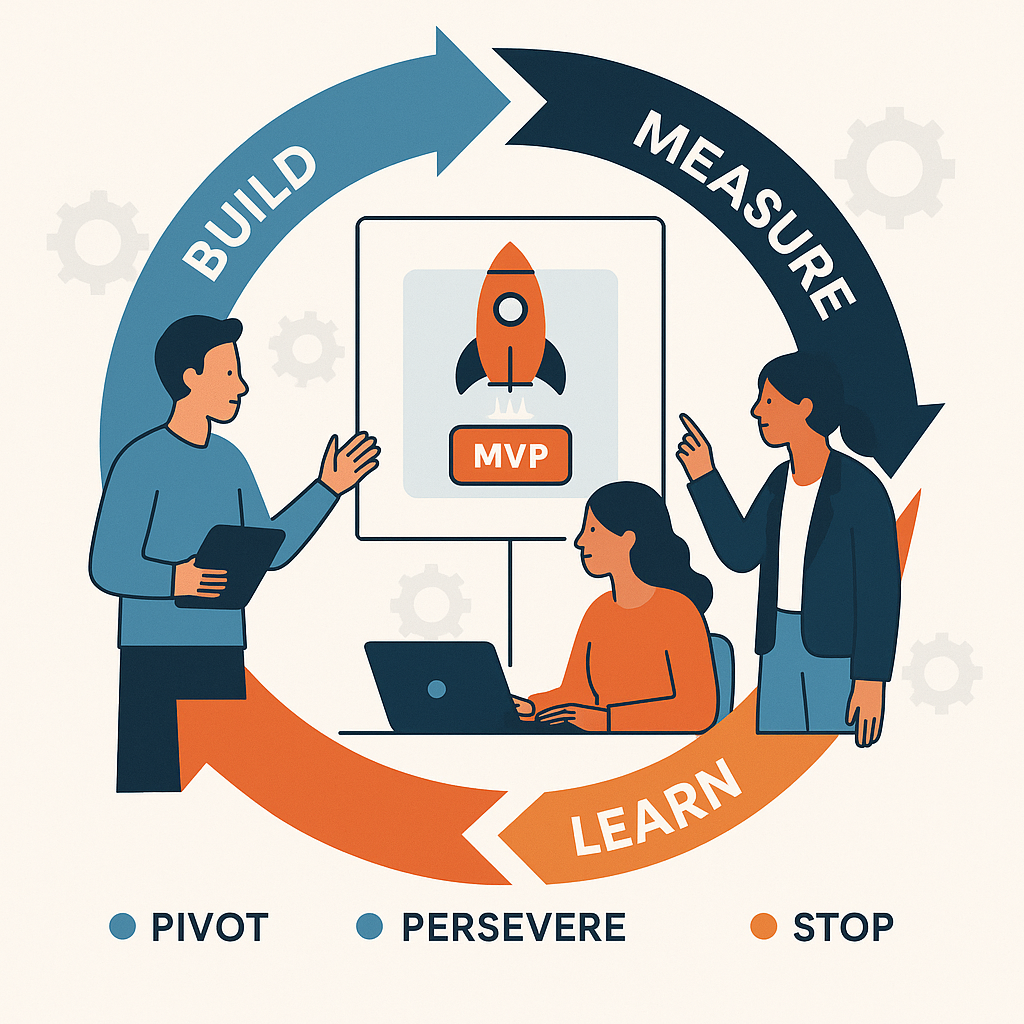
SAFe integrates the Lean Startup Cycle—a continuous loop of Build, Measure, and Learn—into portfolio decision-making:
1. Build: Create an MVP focused on testing a single critical hypothesis.
2. Measure: Collect data and feedback to evaluate assumptions.
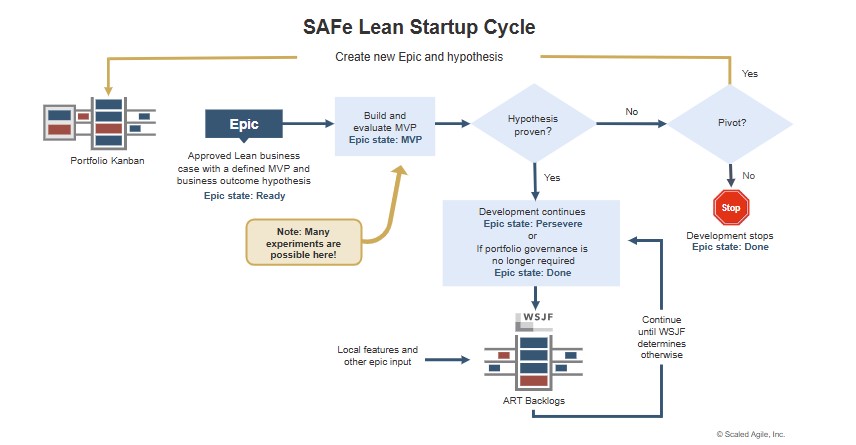
3. Learn: Decide whether to persevere (scale the Epic), pivot (adjust direction), or stop (retire the idea).
This cycle fosters evidence-based investment decisions, reducing the likelihood of funding initiatives that fail to deliver value.
Pivot, Persevere, or Stop
Post-experimentation, organizations use validated learning to decide next steps:
-
Persevere: The hypothesis is proven—continue funding and expand the solution.
-
Pivot: The hypothesis needs refinement—modify the approach and re-test.
-
Stop: The hypothesis is disproven—cease work and redirect funds to higher-value opportunities.
This approach ensures that portfolio investments remain dynamic and responsive to customer insights and market changes.
Benefits of MVP Experimentation
Implementing MVPs at the portfolio level provides several key benefits:
-
Risk Mitigation: Reduce financial exposure on unproven ideas.
-
Faster Innovation: Quickly validate concepts before scaling.
-
Better Alignment: Ensure initiatives support strategic themes and portfolio goals.
-
Learning Culture: Promote evidence-based decisions over opinion-driven debates.
How Bush Agility Can Help
Bush Agility specializes in helping organizations adopt Lean Portfolio Management and MVP experimentation practices. We train and coach leaders to incorporate hypothesis-driven development, align funding decisions to strategy, and foster a culture of validated learning.
Ready to de-risk your big ideas and accelerate innovation?
Contact Bush Agility to learn how we can help your teams master MVP experimentation in SAFe.