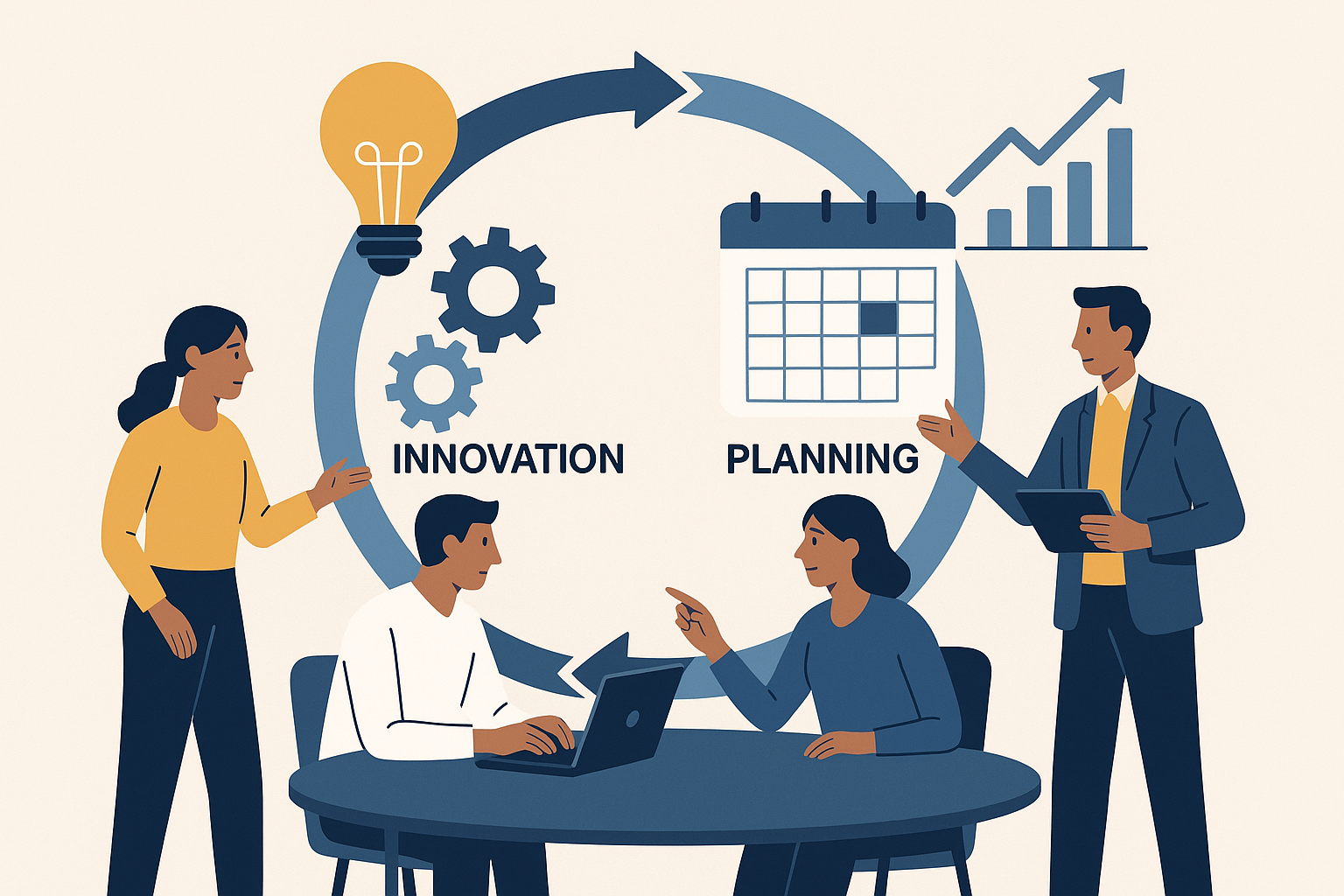
The Innovation & Planning (IP) Iteration: Unlocking Creativity and Planning Excellence
Sep 10, 2025
The Innovation & Planning (IP) Iteration is a cornerstone of the Scaled Agile Framework (SAFe). Occurring at the end of every Planning Interval (PI), this IP iteration provides Agile Release Trains (ARTs) with dedicated time to innovate, refine plans, tackle technical debt, and improve processes.
Unlike development-focused iterations, the IP Iteration shifts the focus from delivery to reflection and growth. Teams can experiment with new technologies, conduct hackathons, improve testing pipelines, and validate architectural assumptions—all critical for sustaining long-term agility and value delivery.
The Common Misconception: “It’s Extra Time”
Despite its importance, the IP Iteration is often treated as optional or “catch-up” time. Teams may see it as a buffer to finish incomplete work rather than as an opportunity for innovation and improvement.
This misunderstanding can lead to:
• Erosion of innovation capacity – Teams never experiment or explore future capabilities.
• Burnout – Without scheduled reflection and recovery, morale suffers.
• Technical debt accumulation – Critical refactoring and system improvements are perpetually delayed.
Benefits of a Well-Executed IP Iteration
When used intentionally, the IP Iteration offers several high-value outcomes:
• Fuels Innovation: Hackathons, proof-of-concepts, and new technology spikes often originate here.
• Drives Relentless Improvement: Supports the Inspect & Adapt workshop, where ARTs review metrics and refine processes.
• Strengthens Planning: Prepares backlogs, aligns roadmaps, and synchronizes cross-team dependencies for the next PI.
• Promotes Team Health: Creates psychological safety and space for creativity, boosting long-term engagement.
How to Maximize the IP Iteration
To unlock the full value of the IP Iteration:
1. Set Clear Goals – Prioritize innovation themes, improvement initiatives, and planning activities.
2. Protect the Time – Avoid using it as a buffer for unfinished PI work; treat it as non-negotiable.
3. Involve Leadership – Encourage business owners and architects to participate in innovation sessions and planning alignment.
4. Celebrate Outcomes – Share prototypes, new ideas, and improvement wins across the ART to foster momentum.
5. Link to Continuous Learning – Use this time to cross-train teams, explore emerging frameworks, and upskill in key competencies.
The IP Iteration’s Role in Business Agility
SAFe emphasizes that business agility depends on continuous learning and relentless improvement. The IP Iteration operationalizes this principle by balancing delivery with exploration, ensuring teams can respond to change, experiment safely, and plan effectively for future time boxes.
Neglecting this iteration sacrifices innovation for short-term gains—an approach that ultimately stifles growth and undermines competitiveness in fast-moving markets.
How Bush Agility Can Help
Implementing IP Iterations effectively requires cultural change, disciplined planning, and alignment across leadership and teams. At Bush Agility, we specialize in helping organizations embed SAFe practices, optimize ART events, and unlock true business agility through expert coaching, training, and staff augmentation.
Explore our SAFe-certified training options or contact us directly to transform how your teams innovate and plan for success.