From Traditional PMO to Lean Portfolio Management: The Future of Agile Leadership
Jul 27, 2025
For decades, the Project Management Office (PMO) served as the backbone of enterprise delivery—focusing on schedules, budgets, and scope management. While this model provided control, it often lacked the speed and adaptability needed for today’s digital landscape. Customer expectations evolve rapidly, and organizations must pivot quickly to stay competitive.
Enter Lean Portfolio Management (LPM)—a SAFe competency that redefines how enterprises connect strategy to execution. Rather than managing individual projects, LPM focuses on aligning investments with value streams, empowering teams, and continuously adapting priorities to maximize customer and business outcomes.
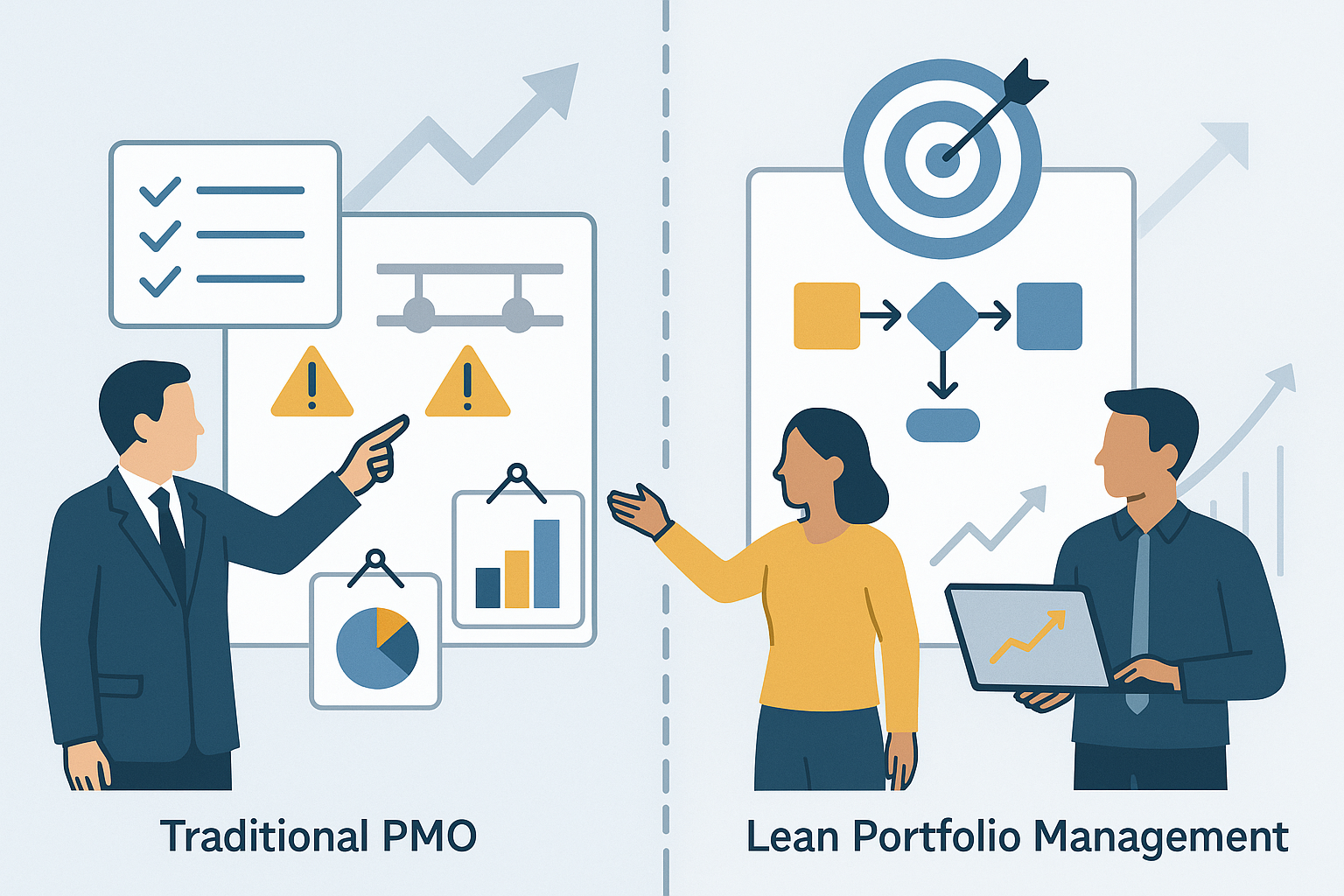
Key Differences: Traditional PMO vs. Lean Portfolio Management
Traditional PMOs often operate within a command-and-control mindset, where work is assigned top-down and success is measured by delivery of scope. LPM, however, is grounded in Lean-Agile principles:
• Value Stream Orientation – Funding and measuring entire value streams instead of isolated projects.
• Decentralized Decision-Making – Empowering those closest to the work to adapt quickly.
• Dynamic Budgeting – Using Lean Budgets with guardrails instead of rigid annual allocations.
• Outcome-Driven Metrics – Prioritizing customer value and business impact over deliverables.
This shift enables organizations to deliver faster, reduce waste, and stay aligned with evolving market demands.
The Leadership Imperative in LPM
Transitioning to LPM isn’t just about changing processes; it’s about evolving leadership behaviors. Leaders must adopt a Lean-Agile mindset, embrace servant leadership, and actively engage in portfolio events like strategy and investment funding workshops, portfolio syncs, and inspect-and-adapt sessions.
Key leadership responsibilities include:
• Setting and Communicating Strategic Themes – Providing clarity on priorities and direction.
• Empowering Value Streams – Trusting ARTs (Agile Release Trains) to deliver outcomes.
• Applying Lean Governance – Balancing autonomy with compliance and financial stewardship.
• Driving Continuous Learning – Fostering a culture of relentless improvement and innovation.
Steps to Transition from PMO to LPM
1. Assess Current Portfolio Practices – Identify gaps in agility, funding, and alignment.
2. Introduce Lean-Agile Training for Leaders – Build understanding of SAFe and LPM principles.
3. Redefine Governance Structures – Move from project-centric oversight to value stream-oriented guardrails.
4. Implement Lean Budgets – Shift to incremental funding and frequent review cycles.
5. Launch Portfolio Kanban – Visualize epics, prioritize initiatives, and manage flow at the portfolio level.
6. Engage Business Owners and Executives – Ensure strategic alignment and active participation in portfolio events.
Why This Transformation Unlocks Business Agility
Organizations that make the leap to LPM often see measurable benefits: shorter time-to-market, higher alignment between business and technology, and improved employee engagement. By focusing on value delivery instead of task completion, leaders create a more adaptive and customer-centric enterprise.
This evolution positions the organization to thrive in an environment where change is constant and speed is a competitive advantage.
How Bush Agility Can Help
At Bush Agility, we guide enterprises through this critical transformation—helping leaders and teams master Lean Portfolio Management, launch value streams, and align strategy with execution. Whether through training, workshops, or staff augmentation, we ensure your organization achieves measurable business agility.