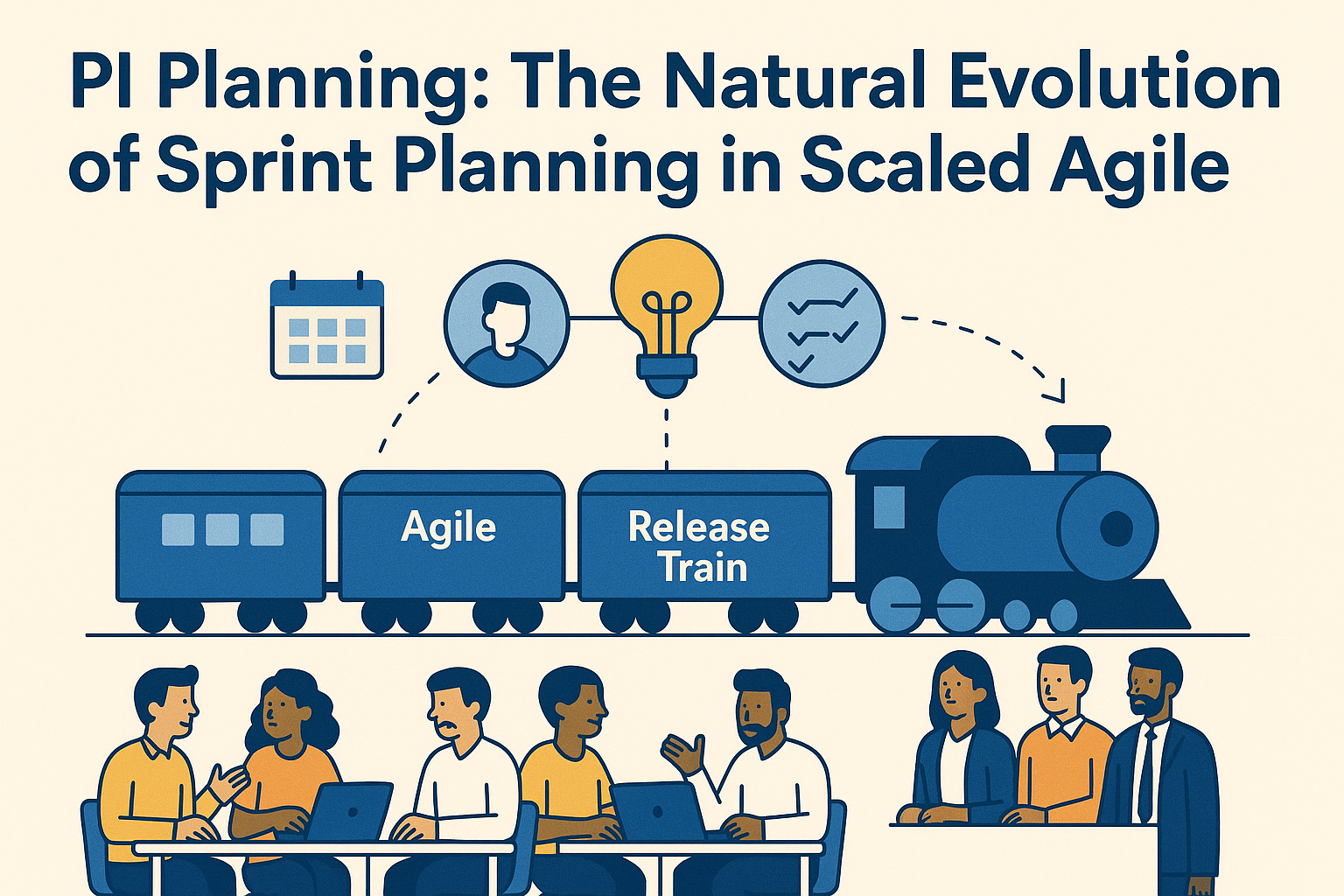
PI Planning: The Natural Evolution of Sprint Planning in Scaled Agile
Jul 29, 2025
In traditional Scrum, Sprint Planning is a vital event where a single team commits to delivering a prioritized set of work within a short iteration, usually two weeks. As organizations grow, however, solutions often require coordination across many teams. This is where Planning Interval (PI) Planning emerges—not as a replacement, but as an evolution of Sprint Planning for the scaled enterprise.
At its core, PI Planning preserves the principles of Sprint Planning: alignment, collaboration, and commitment. The difference lies in scale and impact. Instead of one team aligning with a Product Owner, multiple teams—often 100+ individuals—align with business stakeholders, architects, and product management to deliver features that advance enterprise goals.
Shared DNA: Why PI Planning Feels Familiar
Both Sprint Planning and PI Planning share several key elements:
-
Cadence-based events: Sprints occur every 2–4 weeks; PIs can typically span 8–12 weeks, composed of multiple sprints (iterations).
-
Collaborative forecasting: Teams estimate what can be achieved, identify dependencies, and create objectives.
-
Commitment to outcomes: Teams pledge to deliver value by the end of the cycle.
The familiarity eases the transition. Teams accustomed to Sprint Planning find PI Planning intuitive—just operating on a broader horizon with more voices in the room.
Scaling Beyond the Team: The Agile Release Train
The Agile Release Train (ART) is the backbone of SAFe. It unites multiple Agile teams around a shared vision and roadmap. PI Planning is the event where this alignment is forged. It synchronizes all teams to deliver value cohesively, ensuring integration points are identified and cross-team dependencies are surfaced early.
In this sense, PI Planning is simply Sprint Planning multiplied—with added strategic layers, such as business context, architecture runway, and objectives.
Why This Evolution Matters
The move from Sprint Planning to PI Planning reflects a critical maturity shift. It ensures that as Agile scales:
-
Strategy meets execution: Business priorities flow seamlessly into team-level plans.
-
Dependencies are addressed upfront: Reducing rework and integration challenges.
-
Enterprise alignment improves: Teams deliver incremental value in sync with larger initiatives.
Organizations that master this transition unlock true business agility—responding faster to market changes while maintaining quality and focus.
How Bush Agility Can Help
Transitioning from team-level Agile to scaled planning can feel daunting. At Bush Agility, we specialize in guiding organizations through this evolution—offering SAFe-certified training, coaching, and staff augmentation to ensure successful PI Planning events and long-term adoption of scaled practices.
Ready to elevate your Agile planning? Contact us here to learn how we can help align your teams for enterprise agility.