
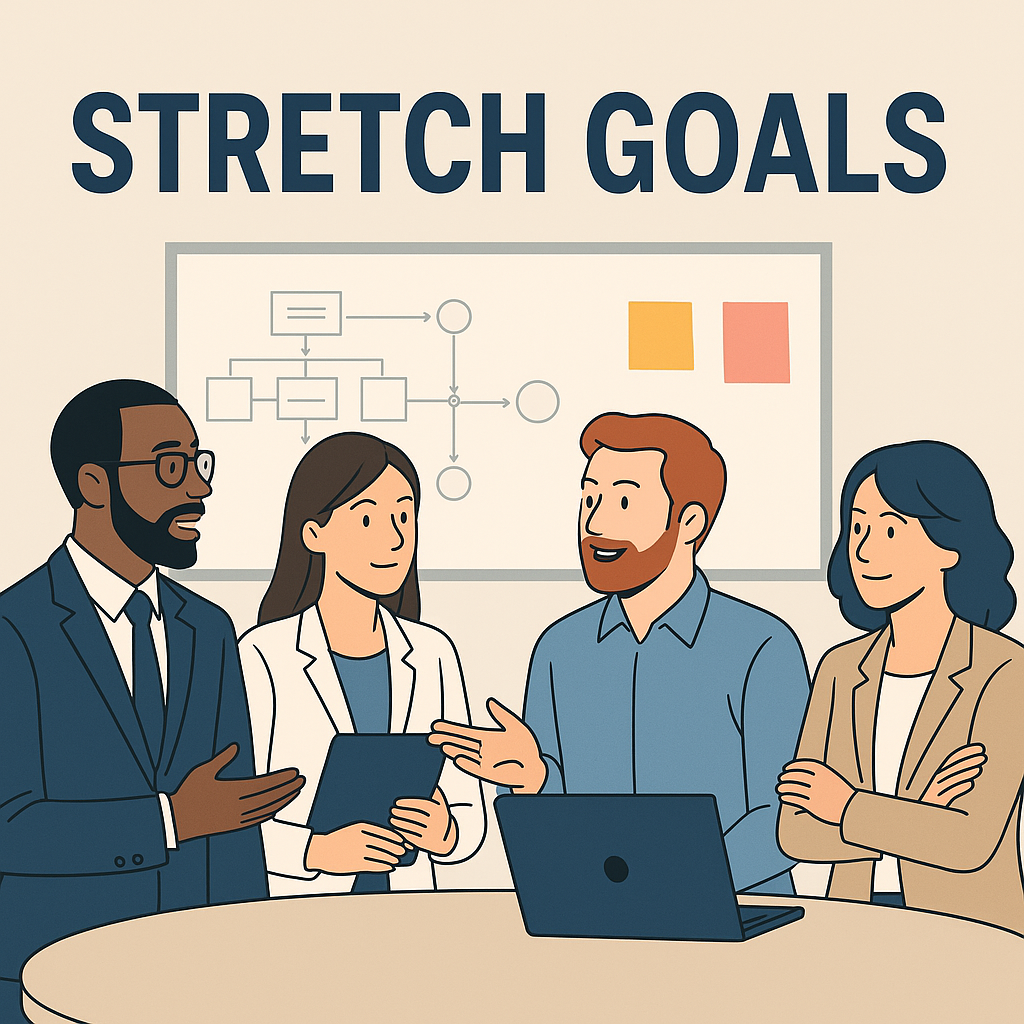
Effective stretch goals are born from cross-team collaboration and long-term planning across the Agile Release Train (ART).
Understanding Stretch Goals in SAFe
Stretch goals are aspirational targets—objectives that push boundaries beyond the team’s committed work. They serve as catalysts for innovation, learning, and system-level progress. But in a SAFe® environment, knowing when and how to use stretch goals is just as important as setting them in the first place.
Too often, Agile teams are tempted to assign stretch goals at the iteration level—two-week iterations/Sprints packed to the brim with work. While noble in intent, this can backfire. Why? Because two weeks is typically not enough time to explore bold objectives that lie beyond the horizon of committed deliverables.
Stretch goals are not about “doing more work faster.” They are about driving strategic growth and advancing the capabilities of the system. That takes vision, time, and alignment—something that the Planned Interval (PI) provides in abundance.
Why the Planned Interval (PI) Is Ideal for Stretch Goals
Planned Intervals in SAFe are typically 8–12 weeks in length, and they offer a structured cadence for planning, execution, synchronization, and feedback. This makes them the perfect environment for introducing and pursuing stretch goals.
Here’s why:
• System Thinking: A PI represents the collective momentum of the Agile Release Train (ART), not just an individual team. Stretch goals pursued at this level engage a broader system and unlock cross-team coordination.
• Time to Experiment: Twelve weeks offers the time and space for teams to conduct spikes, test assumptions, and iterate toward ambitious outcomes—none of which are realistic in a single iteration.
• Strategic Alignment: PI Planning allows all stakeholders—from Product Management to Business Owners—to align on stretch goals that serve enterprise strategy, not just team capacity.
When established thoughtfully, stretch goals can help ARTs move from good to great. They create a shared sense of purpose that inspires innovation, even if the goals are not fully achieved.
How an Agile Release Train (ART) Can Set and Achieve Stretch Goals
The Agile Release Train (ART) is a long-lived team of Agile teams that delivers value on a fixed cadence. During PI Planning, the ART comes together to identify both committed objectives and stretch objectives.
Here’s a practical way to approach stretch goals at the ART level:
1. Reserve Capacity – During PI Planning, teams should plan realistically and leave some capacity for exploration and innovation.
2. Engage Business Owners – Stretch goals should tie to business strategy and outcomes. Business Owners provide the strategic lens.
3. Define Success Criteria – While stretch goals are aspirational, they should still be measurable. Define what “progress” looks like.
4. Inspect and Adapt – At the end of the PI, reflect on what was achieved—even if only partially—and celebrate progress.
ART-level stretch goals encourage cross-team alignment, innovation, and learning in a way that two-week iterations simply cannot match. They foster a culture of growth without overburdening individual teams.
Why Not Set Stretch Goals at the Team Iteration Level?
Here’s the challenge: a single Agile team working within a two-week iteration often doesn’t have the bandwidth or authority to chase goals beyond their committed work. The time horizon is too short, and the scope too narrow.
Stretch goals set at the team level can quickly turn into unrealistic expectations, undermining trust and morale. Even worse, they can dilute focus from committed work and lead to unplanned overwork.
That’s not to say innovation can’t happen in an iteration—but it should be intentionally planned (e.g., via spikes or innovation stories), not bolted on as a “stretch.”
Let the ART and the PI provide the canvas for bold thinking. Let the teams iterate toward value, grounded in clarity and focus.
Looking Ahead: Stretch Goals as a Catalyst for Growth